
What is Data Science?
Data Science continues to be a hot topic among skilled professionals and organizations. that are focusing on collecting data and drawing meaningful insights out of it to aid business growth. A lot of data is an asset to any organization, but only if it is processed efficiently. The need for storage grew multifold when we entered the age of big data. Until 2010, the major focus was on building a state-of-the-art infrastructure. to store this valuable data, that would then be accessed and processed to draw business insights. With frameworks like Hadoop. have taken care of the storage part, the focus has now shifted towards processing this data. Let us see data science basics, and how it fits into the current state of big data and businesses.
Data Science Definition
Data Science can be defined as the study of data, where it comes from, what it represents, and the ways by which it can be transformed into valuable inputs and resources to create business and IT strategies.
Why do businesses need Data Science?
We have come a long way from working with small sets of structured data to large mines of unstructured and semi-structured data coming in from various sources. The traditional Business Intelligence tools fall short when it comes to processing this massive pool of unstructured data. Hence, Data Science comes with more advanced tools to work on large volumes of data coming from different types of sources such as financial logs, multimedia files, marketing forms, sensors and instruments, and text files.
Mentioned below are relevant use-cases which are also the reasons behind Data Science becoming popular among organizations:
- Data Science has myriad applications in predictive analytics. In the specific case of weather forecasting, data is collected from satellites, radars, ships, and aircraft to build models that can forecast weather and also predict impending natural calamities with great precision. This helps in taking appropriate measures at the right time and avoiding the most possible damage.
- Product recommendations have never been this precise with the traditional models drawing insights out of browsing history, buy sale history, and basic demographic factors. With data science, vast volumes and variety of data can train models better and more to show more precise recommendations.
- Data Science also aids in effective decision-making. Self-driving or intelligent cars are a classic example. An intelligent vehicle collects data in real-time from its surroundings through different sensors like radars, cameras, and lasers to create a visual (map) of their surroundings. Based on this data and advanced machine learning algorith, it takes crucial driving decisions like turning, stopping, speeding, etc.
Who is data scientist?
A data scientist identifies important questions, collects relevant data from various sources, stores and organizes data, decipher useful information, and finally translates it into business solutions and communicates the findings to affect the business positively.
Apart from building complex quantitative algorithms and synthesizing a large volume of information, the data scientists are also experienced in communication and leadership skills, which are necessary to drive measurable and tangible results to various business stakeholders.
Top Qualities of a good Data Scientist
- Statistical Thinking
- Technical Acumen
- Multi-modal communication skills
- Curious mind
- Creativity
What are the essential skills to become a Data Scientist?
Contributed by – Saurabh Singh
Data Science is a field of study which is a confluence of mathematical expertise, strong business acumen, and technology skills. These build the foundation of Data Science and require an in-depth understanding of concepts under each domain.
These are the skills you need if you want to become a Data Scientist
- Mathematical Expertise: There is a misconception that Data Analysis is all about statistics. There is no doubt that both classical statistics and Bayesian statistics are very crucial to Data Science, but other concepts are also crucial such as quantitative techniques and specifically linear algebra, which is the support system for many inferential techniques and machine learning algorithms.
- Strong Business Acumen: Data Scientists are the source of deriving useful information that is critical to the business, and are also responsible for sharing this knowledge with the concerned teams and individuals to be applied in business solutions. They are critically positioned to contribute to the business strategy as they have the exposure to data like no one else. Hence, data scientists should have a strong business acumen to be able to fulfil their responsibilities.
- Technology Skills: Data Scientists are required to work with complex algorithms and sophisticated tools. They are also expected to code and prototype quick solutions using one or a set of languages from SQL, Python, R, and SAS, and sometimes Java, Scala, Julia and others. Data Scientists should also be able to navigate their way through technical challenges that might arise and avoid any bottlenecks or roadblocks that might occur due to lack of technical soundness.
Other roles in the field of Data Science:
So far, we have understood what is data science, why businesses need data science, who is a data scientist, and what are the critical skill sets that are required to enter the field of data science. Now, let us look at some other data science job roles apart from that of a data scientist:
- Data Analyst: This role serves as a bridge between business analysts and scientists. They work on specific questions and find results by organizing and analyzing the given data. They translate technical analysis to action items and communicate these results to concerned stakeholders. Along with programming and mathematical skills, they also require data wrangling and data visualization skills.
- Data Engineer: The role of a data engineer is to manage large amounts of rapidly changing data. They manage data pipelines and infrastructure to transform and transfer data to respective data scientists to work on. They majorly work with Java, Scala, MongoDB, Cassandra DB, and Apache Hadoop.
Data Science FAQs
1. What is data science in simple words?
Data science in simple words can be defined as an interdisciplinary field of study that uses data for various research and reporting purposes to derive insights and meaning out of that data. Data science requires a mix of different skills including statistics, business acumen, computer science, and more. Data is widely available today thanks to smartphones and other devices. Businesses are roping this data in to gain insights into customer behavior and more. However, that’s not to say that data science is used only for business development. The uses of data science are rampant across all industries like healthcare, finance, education, supply chain, and more.
The main premise of data science is its ability to transform raw data into valuable information. Data science is indispensable for innovation today and is driving solutions across multiple industries today.
2. What does a data scientist really do?
Data scientists create and use algorithms to analyze data. This process generally involves using and building machine learning tools and personalized data products to help businesses and clients interpret data in a useful manner. They also help in breaking down data-driven reports for a better understanding of the clients. All in all, data scientists are involved at every stage of data handling – from processing it, building and maintaining infrastructure, testing, to analyzing it for real-world use.
3. What is data science example?
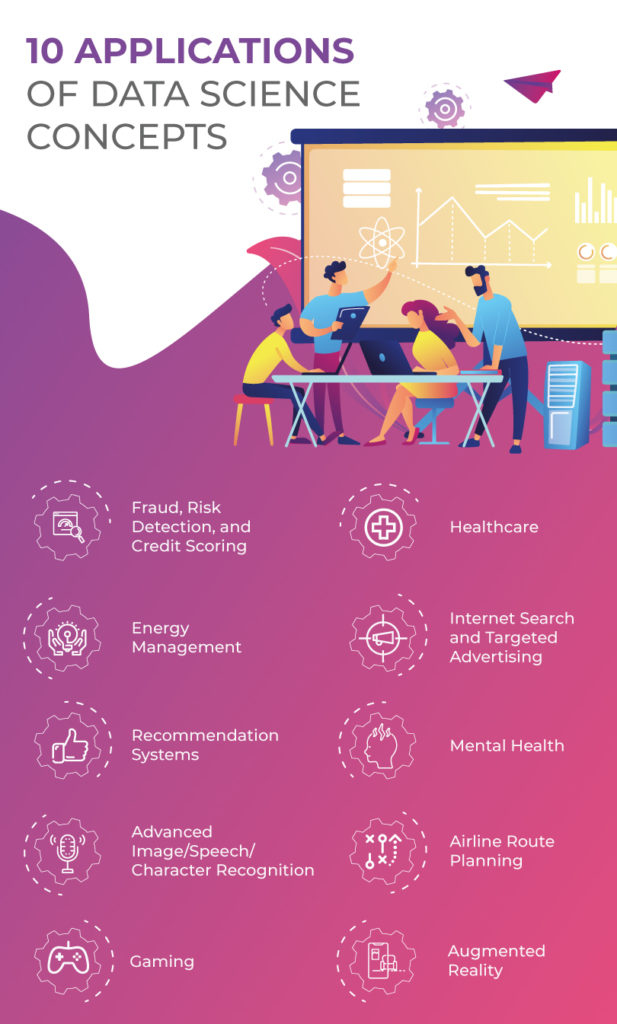
Examples and applications of data science are rampant across all industries today. Some of the most important examples of data science now would be its use in studying the COVID-19 virus and coming up with a vaccine or a treatment. Examples of data science also include fraud detection, automation in customer care, healthcare recommendations, fake news detection, eCommerce and entertainment recommendation systems, and more.
4. What is data science course eligibility?
The course eligibility for Data Science is a bachelor’s degree in computer science, mathematics, IT, statistics, or any related field. Students in their final semesters of bachelor’s degree can also enroll in Data Science courses. Additionally, candidates should also have a minimum of 60% aggregate in their Xth, XII, and bachelors.
5. Is data science a good career?
Yes, Data Science is a good career path, in fact, one of the very best right now. There isn’t a single industry right that couldn’t benefit from data science, making data science roles rise every year. Apart from this high-demand candidates also meet with some of the highest salaries in the market. According to Glassdoor, Data scientists make an average of $116,100 per year.
6. Do data scientists code?
Yes, Data Scientists code in most cases. Depending on the role, data scientists are required to code for various process-related tasks. Data scientists need to have good knowledge of different programming languages like C/C++, SQL, Python, Java, and more. Python has emerged as the most widely used programming language among data scientists.
7. What problems do data scientists solve?
From addressing climate change problems to creating recommendation systems in streaming services, data scientists are practically solving every kind of problem around the world. Since data science has proved to benefit all industries, leadership teams are increasingly investing in data science to come up with solutions around the business. The applications of data science range from creating sustainable development goals for stakeholders, creating healthcare solutions to architectural layouts.
8. Why do data scientists quit?
The top reasons why data scientists are quitting their jobs include unrealistic expectations at work and isolated working conditions. More often than not, data scientists find themselves disappointed with the gap in their expectation vs reality when it comes to the role they join. From afar, the job of a data scientist might look fancy but in reality, it involves a lot of hard work. It is not without reason that companies are paying the big bucks to data scientists. They handle a lot of reports, churning a lot of numbers and figures every day which might be a little exhaustive after a while. The other reason is data scientists often work independently with minimal dependency on the team. While this is a good thing for getting the work done, it can also lead them to feel isolated and disconnected.
9. Can I learn Data Science on my own?
You can definitely start learning data science on your own, but in order to become an expert, you must enroll in a course that offers you proper training, guidance, and mentoring. Data science has numerous applications throughout the world and to make you job-ready, you need industry insights and knowledge of real-world applications which you can get only through high-rated certifications.
10. What should I learn first to become a data scientist?
In order to become a data scientist, the first thing that you need to learn is python programming, R programming, SQL database, and more. Once you get a proper understanding of these programming languages, it will become easier for you to get a hang of the basic tools and algorithms used in data science. However, it is best to enroll in a course to get a complete understanding of the domain and to master it.
Why Choose eSource Software?
eSource Software is among the leading software outsourcing companies in Malaysia. Providing quality software outsourcing services, catering to clients across the globe. for projects of any size and scope.
Get in touch today to learn more about our services!
Contact us:
eSource Software, 17-01, Kapitan Square, Buckingham Street, 10200 George Town, Penang, Malaysia.
Call : (006) 012-4377440
Email : esourcetechnology@gmail.com
Website : www.esource-malaysia.com
Malaysia Cities: Alor Setar, Semporna, Putrajaya, Sandakan, Kuantan, Johor Bahru, kedah, Alor Setar, Perlis, Kuala Terengganu, Kota Bharu, Miri, Kuching, Kota Kinabalu, Ipoh, Perak, Malacca, Negeri Sembilan, Langkawi, George Town, Penang, Pahang, Selangor, Terengganu, Kuala Lumpur, Sabah, Sarawak, Labuan.
Mobile App Penang | Mobile App Kuala Lumpur | Mobile App Selangor | Mobile App Johor Bahru | Mobile App Singapore | Software Pahang | Software Sabah | Software Sarawak | Software Malaysia | Software Kuala Lumpur | Software Singapore | Software Brunei | Software Selangor | Software KedahLondon | New York | Hong Kong | Singapore | Toronto | Frankfurt | Dubai | Taipei | Brussels | Tokyo | Chicago | New DelhiBeijing | Sydney | LosAngeles | Vancouver | Paris | Copenhagen | Berlin | Miami | Rome | Boston | Seoul | ViennaMumbai | Warsaw | Shanghai | San Francisco | Dublin | Philadelphia | Las Vegas | Budapest | Montreal | Barcelona | Abu Dhabi | MunichDallas | Manchester | Bangalore | Amsterdam | Lisbon | Madrid | Prague | Geneva | Milan | San Diego | Auckland | HamburgRiyadh | Saint Petersburg | Rio de Janeiro | Melbourne | Manila | Moscow | Sao Paulo | Zurich | Chengdu | Stockholm | Hyderabad | OsloDenver | Buenos Aires | Helsinki | Luxembourg | Orlando | Washington, D.C. | Atlanta | Johannesburg | Bangkok | Birmingham | Brisbane | CalgaryTianjin | Sofia | Athens | Kyoto | Wenzhou | Guadalajara | Phoenix, Arizona | Bucharest | Houston | Nanjing | Chennai | KyivNairobi | Jeddah | Shenzhen | Busan | Cape Town | Ho Chi Minh City | Mexico City | Jakarta | Cairo | Guangzhou | Dhaka | LagosOsaka | Istanbul | Kuala Lumpur | Zagreb